Exercising With a Cold: Below the Neck… no!
Exercising With a Cold: Below the Neck… no!
Two weeks after the first symptoms, on 1 April, I’m back on the bike and almost feeling normal. Today’s bike ride around Central Park didn’t break any land speed records and there were no 450 watt hill climbs, but it was a momentous ride nonetheless since I think that this damn common cold gone rouge has finally run its angry course.
[embedded widget removed: ./Messages from the Pale Blue Dot_ April 2010_files/30128758.html]
I’m always surprised, after nearly fifty-seven years on the planet, that I can learn something new about how to exercise and what it takes to stay healthy. During the last two years, I’ve discovered how important it is to develop the fifth pillar of good health through yoga; balance and flexibility (the other four pillars being cardiovascular conditioning, excellent diet, strength training and sleep.) But this month’s master class in life-learning really snuck up on me and was a hard-won lesson on when not to exercise with a cold.
There are times when I know that I’m run down and need to take a break. These private little signs are easy to read and I should have paid attention to them towards the end of last month. During the month of March I traveled around the world twice, competed in the 117 km Cape Argus Classic bike race in South Africa and then, the next Sunday, ran a really fantastic half-marathon in New York City. Then, as the worst fiscal year (in terms of fundraising) finally came to an end, we entertained family from around the country in New York and I organized some events at the UN for my friend, Christiana Figueres. By 31 March, I was totally wiped out and should have seen the signs, but if you don’t listen to your body there is a certain point where it takes charge and lays you out for the rest you haven’t taken. And, on 1 April, I went out for a long bike ride and came back with a ticklish cough, which is always the first sign of a chest cold coming on. My immune system was out of whack and something wickedly viral had opportunistically taken advantage of the opening to lodge deep in my alveoli.
No, I probably shouldn’t have gone to yoga the next day and most assuredly shouldn’t have run in that 10K race on Saturday morning. And this brings us to the lesson learned: You should not exercise with a cold if the symptoms are primarily below the neck because the force of heavy breathing can drive the virus deeper into your lungs. So, hammering out a really fast few first miles that morning was a huge error and one that I have been paying over the last two weeks. That race was really an awful experience and I really couldn’t figure out that might be the matter, since I had run so fast just two weeks before. The “matter” was that I had a low-grade fever and the start of a respiratory infection that then turned into a serious mess when I went red-line for 51 minutes around Central Park.
Now, if I was one of my kids, I would have kept me home from school. But, feeling characteristically indestructible, I got up at 3:00 am on Monday morning, went out to JFK airport and flew through San Francisco to Seoul, Korea, changing about twelve times zones and taking my lungs into 11% humidity and de-pressurizing and re-pressurizing them several times. Then, just to make sure that I had done all of the things that you definitively do not want to do when you have a respiratory infection, I stuffed tissues in my trench coat pockets and spent six hours taking subways and attending high pressure meetings with the Ministry of Foreign Affairs of the Republic of Korea. By the time I got back to my hotel that day, I was phlegmy and feverish and had probably infected half of the other riders on the Korean subway system.
Now, the smart thing to do at this point would have been to call my travel agent and ask him to rebook my flights so that I could stay at my hotel in Incheon to sleep and recover for forty-eight hours before continuing on my trip. But, the climate change negotiations were starting up again for the first time after the calamity of Copenhagen and I needed to get to Bonn, Germany by the following evening. So, I boarded the plane and was so glad not to be seated next to anyone on the flight since I was the person who I would never like to sit next to on an airplane. My biggest fear was going through the health checks in the airport, where they thermally scan each passenger for fever and I tried to appear as “cool” as possible. My second greatest fear is that my ears would never depressurize or that my eardrums would shatter from the change in altitude, but somehow I managed to pinch my nose and blow hard enough to force air up into my eustachian tubes for that blessed hiss of relief when the pressure is equalized.
Well, someone how I made it to Bonn and managed to make it through three days of meetings with donors and the assorted diplomats, scientists and activists who attend these events. My photos from these three days are available at http://www.iisd.ca/climate/ccwg9/ and our final report of the meeting can be found at http://www.iisd.ca/vol12/enb12460e.html
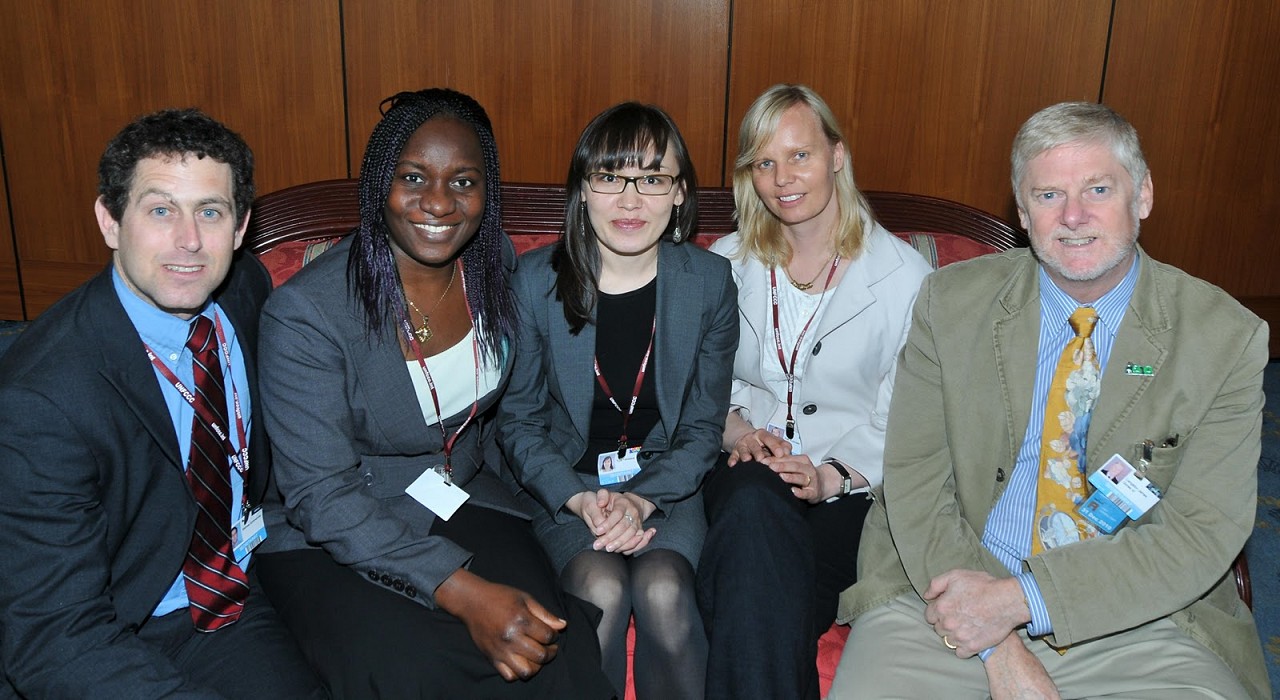
ENB team in Bonn L-R: Matt Sommerville (US), Tomi Akanle (Nigeria), Yulia Yamineva (Russian Federation), Kati Kulovesi (Finland) and Kimo Goree, Director, IISD Reporting Services.
On Monday I flew back from Frankfurt, trying carefully not to terrify the other passengers with the death rattle in my lungs. And then both on Tuesday and Wednesday of this week, managed to slowly inch my way back to health with yoga and some short runs on the treadmill. Today was the longest and most strenuous workout and I really didn’t have half of my usual energy on the bike. It’s amazing how an inflammation of the respiratory tract can result in such diminished performance, since I know that only three weeks after my best race, I certainly could not have lost my conditioning… it has to be something about the lungs and how the body has diverted energy into repair and recovery rather than athletic performance.
So, the lessons learned: a) cumulative stress, both mental and physical, does not dissipate as quickly anymore and I’m finding I need more time to recover from big events and the pressures of work; b) at the first signs of a chest cold, do not exercise.. but rather get sleep. Exercise can only force the cold deeper into your chest; c) in the parabolic curves that characterize the fluctuating levels of fitness and fatigue, the fitness level will still increase over time, but the fatigue curves are flatter than ten years ago, so that in the desire to move that fitness line up you have to respect the time it takes for the fatigue line to recover.
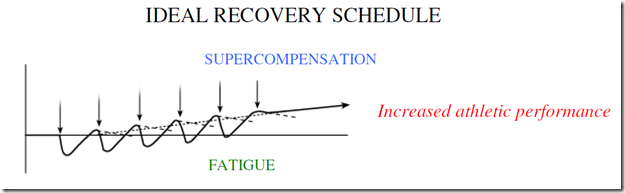
Graphic clipped from an article by J. Shea